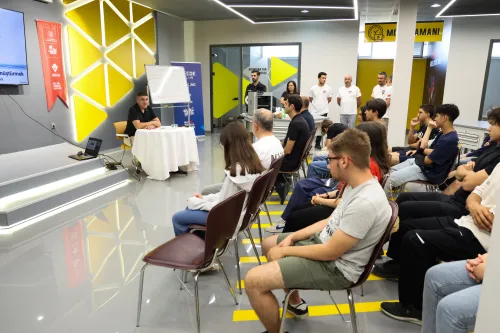


Nursing students studying at Burdur Mehmet Akif Ersoy University (MAKÜ) are overcoming the stress and anxiety they experience before clinical practice thanks to high-fidelity simulators. The application area, which is one of the few simulation centers in Turkey, offers students the opportunity to receive practical training close to real patient experience starting from their first year.
Thanks to the simulators that can speak and answer questions posed by students, they can develop their patient assessment, communication, and clinical practice skills in a safe environment. The applications carried out in rooms specially prepared for adult health, child health, obstetrics, and mental health increase students' professional confidence while also reducing the fear of making mistakes.
During the training process, the applications are not limited to simulators. Students specially trained under the standard patient model also contribute to the applications by taking on the role of a patient according to real clinical scenarios. Thus, both technical skills and communication processes with patients can be experienced firsthand.
‘From Skill to Confidence’ project
Assoc. Prof. Dr. Nevin Uslu, Head of the Nursing Department at MAKÜ Cevat Sayılı Faculty of Health Sciences, stated in her explanation about the ongoing project that they aim to reduce the anxiety experienced by students before clinical practice. Uslu expressed that the project titled “From Skill to Confidence: Heart-Lung Examination” was implemented as a BAP project with the support of the university administration, stating that students receive training with both high-fidelity simulators and standard patient applications.
Uslu noted that the simulation center has provided an important educational infrastructure for the university, mentioning that the center includes rooms for adult health, obstetrics, child health, and multipurpose applications. She also stated that in the mirrored room prepared for mental health nursing training, students will gain practical experience in communication skills and professional approach.
Education curriculum is expanding
Uslu emphasized that simulation training will not be limited to the project scope, stating that they aim to spread this model to all classes. She expressed that the applications starting with basic health assessment in the first year will continue in an integrated manner with internal medicine, surgery, obstetrics, and child health courses in the following years.
Uslu noted that students experience intense anxiety before the application but gain confidence as the process progresses, stating that the analysis sessions conducted after the application are one of the most important stages of the training process. Uslu mentioned that in these sessions, students have the opportunity to analyze their strengths and weaknesses, and the feedback received has been very positive.
The future nursing education model
Uslu pointed out that the simulation center is the future nursing education model, stating that it is of great importance for students to gain experience in a safe environment before encountering real patients in terms of professional success. Uslu stated that their goal is to provide the country with more equipped, confident, and conscious nurses, adding that the simulation-supported education model will make significant contributions to the quality of education in the coming years.